Controversy, A Shutdown, and Rebirth—Petty Enterprises in the mid-1980’s (PART 3)


Imagine a team winning ten championships, then sliding a bit down the Nascar totem pole but still winning races.  Imagine this team making driver and manufacturer changes, then shutting down due to a lack of sponsorship.  Then imagine this team simply starting up again a year later.
Well, that was Petty Enterprises in the mid-1980’s, as Nascar’s most-fabled team dealt with change, controversy, and closing down, only to restart again a year later.


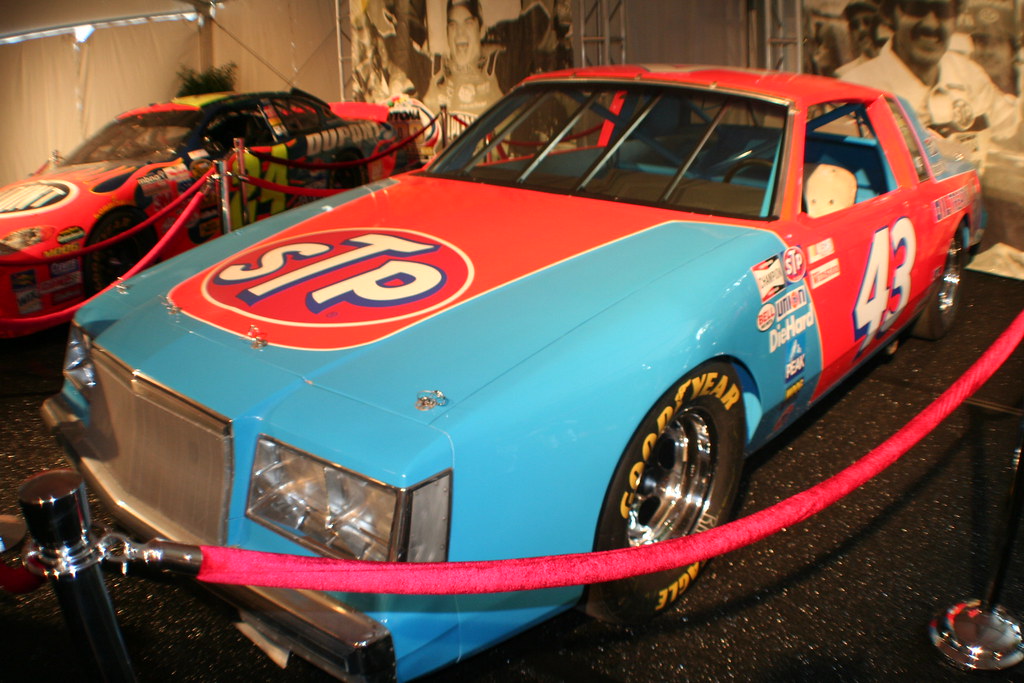
The King's homecoming car

1986—HOMECOMING
Unsurprisingly, Richard Petty was looking to leave the unreliable Curb team, feeling he still had good years left in him.  Surprisingly, he would wind up where it all started—back at Petty Enterprises.  Richard himself would help lead a revival of his family-founded team, bringing back his famed #43 and, more-importantly, lucrative sponsorship from STP.  Furthermore, Petty Enterprises would return to fielding Pontiacs, ending their brief, unsuccessful flirtation with the Ford Thunderbird.  But that’s not all.
Dale Inman had won a record-settling eighth championship as a crew chief for Terry Labonte in 1984, but couldn’t resist a chance to, like his cousin Richard, come back to where it all started.  So in 1986 Inman returned to the pit box at Petty Enterprises, also taking on an increased leadership role with the team.  With Maurice and Lee taking reduced roles with the team, Richard Petty and Dale Inman were now in control at Petty Enterprises.
Funnily enough, Richard would finish the same spot in drivers’ points that he did the year before with Curb—14th.

1987-1992—A SLOW SLIDE
Richard Petty's final car
The reformed Petty Enterprises had one last hurrah in 1987, posting nine top-five race finishes, good enough for an 8th-place finish in the final season points standings.  However, issues with Pontiac’s ever-changing body types, Richard’s advancing age, and (ironically) the encroaching preponderance of multi-car “mega-teams” would see Petty Enterprises fade into mediocrity.  1988 would see Richard post his last top-five race finish of his career, while 1989 would see him fail to qualify for four races, leading to Nascar implementing the “Past Champion’s Provisional”.  By The King’s final season as a driver in 1992, it appeared that Richard had held onto the steering wheel for too long.

1993-2008—CHANGE, TRAGEDY, AND THE END (FOR NOW)
Once Richard Petty stepped out of the driver’s seat, there was some hope that new blood could return Petty Enterprises to its former glory.  However, while drivers like Bobby Hamilton and John Andretti would return the 43 to victory lane, the team was a shadow of its former self.
Meanwhile, new hope sprang up with two more family-developments in the late-1990’s.  Kyle Petty merged his Petty-allied team fully into Petty Enterprises, taking on a bigger leadership role with years of seasoning under his belt.  Furthermore, Kyle’s son (and Richard’s grandson) Adam Petty was developing into a promising future star, using his on-track talent, family name, and sponsorship appeal to bring much-needed money and exposure to the team.  With a manufacturer change to a returning Dodge on the horizon, the future, for the first time in decades, looked bright.
One of Kyle Petty--and Petty Enterprises'
--final cars
However, 2000 would see tragedy strike the team.  Lee, the team’s founder, passed away from natural causes.  Then, shortly after making his Cup debut in anticipation of a full-time run in 2001, Adam was killed in a practice crash at New Hampshire Motor Speedway.  The death of such a young, promising racer shook the team to its very core.  Kyle’s plans to ease into driving retirement were put on hold, and the team’s switch to Dodge in 2001 would fail to net positive results.
Thad Moffitt--the next generation of Petty
In the mid-2000s Richard would take one last gamble on the team’s success, signing former champion Bobby Labonte to team with Kyle in the drivers’ seats.  However, it still wasn’t enough, and an ownership stake was sold in 2008 to investment firm Boston Ventures.  When sponsor General Mills (STP’s replacement) announced their departure from the team, Boston Ventures essentially shuttered Petty Enterprises as a racing operation.  A period of uneasiness between Richard and Kyle followed over the way things ended at Petty Enterprises, notably Kyle’s decision to run a partial schedule in order to pursue a broadcasting career.  Richard, for his part, continued the Petty legacy by taking his famed #43 to what would become Richard Petty Motorsports, a team he still co-owns today.
As for Petty Enterprises, it has reinvented itself as Petty’s Garage, making performance vehicles for everyday drivers.  Occupying the same hallowed Level Cross ground as the race team before it, Petty’s Garage shares space with the Richard Petty Museum, which shows the history of the team’s former glory.
While the Petty Enterprises story seems to have a firm “The End” on it, there’s always the chance—however small—that a younger member of the Petty clan could restart the team in the future.  After all, when you were in business for fifty years and have already come back from a one year break, what’s one decade off?
Controversy, A Shutdown, and Rebirth—Petty Enterprises in the mid-1980’s (PART 2)


Imagine a team winning ten championships, then sliding a bit down the Nascar totem pole but still winning races.  Imagine this team making driver and manufacturer changes, then shutting down due to a lack of sponsorship.  Then imagine this team simply starting up again a year later.
Well, that was Petty Enterprises in the mid-1980’s, as Nascar’s most-fabled team dealt with change, controversy, and closing down, only to restart again a year later.
1984—CURB YOUR ENTHUSIASM
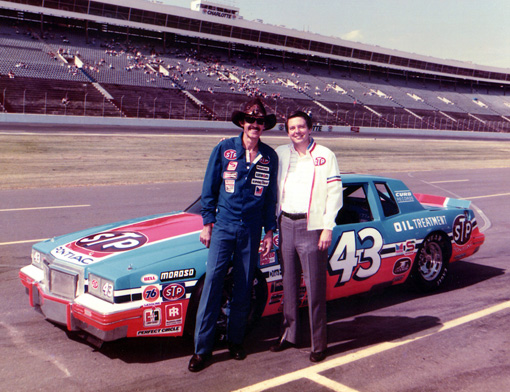
Richard Petty & Mike Curb
To the shock of the Nascar world, Richard Petty departed his family-owned team to run for music impresario and politician Mike Curb in 1984, taking sponsor STP and car number 43 with him.  Originally Richard’s deal was to run with engine support and possible partial ownership from the RahMoc team, only for the RahMoc-Curb portion of the three-way agreement to fall apart.  In order to salvage his season, having already signed an agreement with Curb, Petty brokered a deal to run with DiGard engines for 1984.  While DiGard was known for making stout, powerful engines, they were also known for being notoriously difficult to do business with.
Most fans know the highlights of Richard Petty’s 1984 season—wins number 199 & 200, the latter of which came with president Ronald Reagan in attendance.  However, friction behind the scenes between Curb and DiGard regularly threatened to derail the team’s efforts.  In fact, a payment disagreement almost saw DiGard repossess an engine right out of Richard’s race car—at the Firecracker 400 race where he’d win his 200th race!  Not surprisingly, the Curb-DiGard agreement was allowed to expire.
Meanwhile, over at Petty Enterprises, things weren’t much better.  The switch to Ford saw Kyle slip in drivers’ points from 13th to 16th.  However, a greater cause may have been the external pressures of running for Nascar’s most-famous team.  Forced to race under his father and grandfather’s enormous shadows, Kyle had the added pressure and responsibilities of trying to run part of the business side of the team.  Feeling he needed to get back to being a driver-only, as well as needing to establish himself away from the Petty homestead in Level Cross, Kyle left the team at the end of the season—taking his sponsorship (7-Eleven) and car number (7) as his father did before him—to longtime Ford team Wood Brothers Racing.

1985—1 IS THE LONELIEST NUMBER
Dick Brooks and the unsponsored
Petty Enterprises #1 Ford
In 1985 Kyle Petty would have a breakout year for the Wood Brothers, finishing in the top-ten in drivers’ points for the first time on the back of seven top-five race finishes.  However, there was little else to celebrate around the Petty family otherwise.  While Richard had gotten away from the fractious Curb-DiGard engine agreement, he was now stuck with racing engines from, of all people, Dan Gurney’s All-American Racers, an open-wheel team in which Curb had an ownership stake.  The 43’s on-track performance suffered greatly as the team frequently dealt with engine failures, posting a single top-five race finish all year.  By mid-season, The King was looking to get out of his deal with Mike Curb.
Meanwhile, Petty Enterprises—now helmed primarily by Maurice Petty—was stuck without much of anything.  Now running car number 1, the team had no driver, no sponsor, and little beyond some leftover Fords from the previous year and the team’s historical pedigree.  In a move that would’ve been considered unfathomable a few years prior, Petty Enterprises only raced four times that year—three with journeyman Dick Brooks, and once with upstart Morgan Shepherd.  Not since 1965—when Nascar infamously outlawed the Pettys’ prized Hemi engine, forcing a Plymouth-backed boycott—had Petty Enterprises not run most or all of the Cup Series schedule.  Concurrently, the team essentially shut down, with the Level Cross garages mostly shuttered and seemingly ready to pass into history.

Or were they?

Check in a few days from now for Part 3

Controversy, A Shutdown, and Rebirth—Petty Enterprises in the mid-1980’s (PART 1)


When Furniture Row Racing announced that they would be shutting down at the end of the 2018 season, fans were shocked that a championship team with a superstar driver could fold so quickly.  While there were a number of understandable outside factors—most notably 5-Hour Energy’s decision to leave Nascar—many found it strange that such a successful team could simply give up the ghost so quickly after such success.
But you know what’s even stranger?
Imagine a team winning ten championships, then sliding a bit down the Nascar totem pole but still winning races.  Imagine this team making driver and manufacturer changes, then shutting down due to a lack of sponsorship.  Then imagine this team simply starting up again a year later.
Well, that was Petty Enterprises in the mid-1980’s, as Nascar’s most-fabled team dealt with change, controversy, and closing down, only to restart again a year later.

Family patriarch and team founder Lee Petty
BACKGROUND—A FAMILY AFFAIR
Founded in 1949 in Level Cross North Carolina, Petty Enterprises (formerly Lee Petty Engineering) had always been a team owned by Pettys, for Pettys.  After stepping out of the driver’s seat following a harrowing crash in 1961, Lee maintained executive management of the team while the next generation took control of the on-track product.  Richard Petty would surpass his father’s three Cup championships, winning seven of his own, all in Petty-owned equipment.  Richard’s brother Maurice tuned the engines, getting the most out of already stellar equipment, making “Petty power” the envy of the rest of the garage.  Cousin Dale Inman, meanwhile, innovated the position of crew chief, making in-race calls for the famed 43 car.

1979-1983—SPLINTERING & THE NEXT GENERATION
Richard Petty's final Daytona 500 winning car
1979 would prove to be a pivotal year for Petty Enterprises, a sort of “tipping point” for what was far and away Nascar’s most-successful team.  Richard Petty would win his seventh and final championship, rebounding from a winless 1978 that would see him switch from Dodge to GM brands.  Furthermore, Richard’s son Kyle would make his racing debut in a second Petty Enterprises car.  At the time, running more than one full-time team was thought to be near-impossible, and unfortunately the Pettys were not up to the challenge.  Friction developed on the team with much of it centering on engine builder Maurice, wondering who was getting the “good” equipment.  Reportedly, the team began to splinter into two camps—one with Lee and Maurice, the other with Richard and crew chief Dale Inman.

However, following the 1981 Daytona 500—one that Richard would win for a record-setting seventh and final time—Inman would depart Petty Enterprises.  After spending a winless 1982 adjusting to new manufacturer Pontiac (which Petty would race for for the rest of his career), 1983 would see Petty rebound with three wins—but not without controversy.  In Petty’s last win of that year, the 43 was found to be running improper tires and an oversized engine.  This would prove to be the breaking point for Richard, who stepped up efforts to drive for a new team for the following year.  Meanwhile, Petty Enterprises would concentrate on Kyle Petty’s efforts, buoyed by Kyle’s sponsorship with 7-Eleven and arrangement to run Ford equipment.

Check back for Part 2