Programming Note: I'll be in the pits for Saturday's Xfinity Series race.
The Mid-Atlantic region of the US has long been better-known as a hotbed for drag-racing than for its interest in stock-car racing. So it follows that, other than the venerable Dover International Speedway, all of the other tracks in the region have long-since closed, falling prey to rising property values and a general lack of interest in oval racing in the area. Here’s a look back at four of the region’s top tracks from the past:
 |
Langhorne Speedway--note the proximity
to housing developments |
Langhorne Speedway (Langhorne, PA)
The mile-long track earned its nickname “The Big Left Turn” from it’s almost-perfect circle shape. However, it earned its other nickname “The Track That Ate Heroes” from it’s reputation for numerous fatalities. Furthermore, the unofficial Turn 2 (remember, the track was a circle) was nicknamed “Puke Hollow” for its rough surface, rutted from years of abuse to its dirt base. Hosting numerous top racing series, Nascar was no exception, hosting “Strictly Stock”/Grand National (later renamed the Cup Seires) races from 1949 through 1957. Luminaries such as Curtis Turner, Herb Thomas, Dick Rathmann, and Tim & Fonty Flock notched wins at the track. Shut down after the 1971 racing season, the property is currently the site of a shopping plaza.
 |
Trenton International Speedway in its
final form |
Trenton International Speedway (Trenton, NJ)
Originally a half-mile dirt track, the circuit was doubled in size after World War II, and was paved in 1957. Then, in 1969, the track was increased in size once more, topping-out at 1.5 miles long. However, the final iteration of the track, located at the New Jersey State Fairgrounds, was best-known for its bizarre “kink” in the backstretch, which required drivers to make a slight RIGHT-hand turn. In addition to IndyCar and Modified races, the Nascar Cup Series ran eight total races at the track, including six straight from 1967-1972, and had a scheduled race for 1973 that was rained-out and never rescheduled. The track would shut down in 1980, soon to be followed by the fairgrounds itself, which have since been turned into a sculpture garden.
Flemington Speedway (Flemington, NJ)
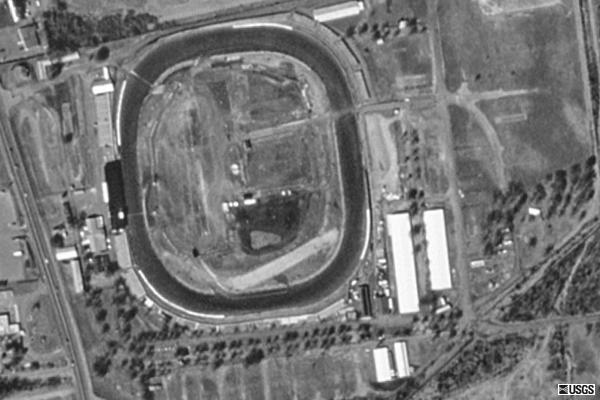 |
| Flemington Speedway |
Opened in 1915, the distinctive square-like 5/8ths mile track didn’t attract national attention until it was paved in 1990. Truck Series races were held from 1995-1998, with Ron Hornaday Jr. as the only repeat winner. While a popular local track as a dirt facility, the track was unable to maintain profitability as an asphalt track and is now the site of a Lowe’s “big box” hardware store. However, the track contributed to Nascar’s modern-day history in two interesting ways. After a number of serious head-on crashes (due to the track’s square-shape), foam bricks were installed in the corners, which, while not optimum from a safety or clean-up standpoint, were able to stop the rash of driver injuries, being the spark that would eventually lead to Nascar’s current SAFER barriers. Furthermore, one of the drivers seriously injured pre-foam was local driver Ray Evernham, who instead became a crew chief upon recovery. If not for this injury, who knows if he would have gone on to crew chief for Jeff Gordon, or lead Dodge’s return to the sport.
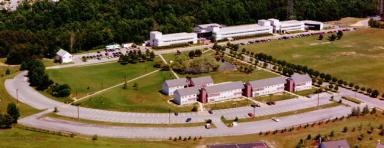 |
The track's surface reused as the
school's parking lot |
Beltsville Speedway (Laurel, MD)
Located in the Washington DC suburbs, Beltsville Speedway had a short lifespan, opening in 1965 and closing in 1978. While ten Nascar premiere series (aka Grand National or Cup) were held at the track, local racing was its bread-and-butter, and eventually its downfall. Noise restrictions forced the track to first erect a sound wall barrier, then force cars to run with mufflers. Uniquely, after shutting down the track property was bought by Capitol Technical University, which maintains a portion of the racing surface as a parking lot.


